League of Gentlemen Live Again Torrent
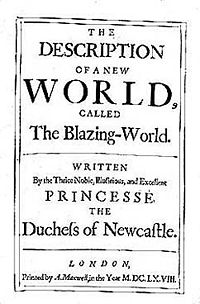 Title page of Margaret Cavendish'southward The Description of a New World, Called The Blazing-World, reprinted 1668 [originally published 1666] | |
| Author | Margaret Cavendish |
|---|---|
| Country | England |
| Language | English |
| Genre | Science fiction, utopian |
| Published | 1666 (1666) |
The Description of a New Globe, Called The Blazing-World , amend known equally The Blazing Globe , is a 1666 piece of work of prose fiction past the English writer Margaret Cavendish, the Duchess of Newcastle. Feminist critic Dale Spender calls it a forerunner of science fiction.[1] It can also be read as a utopian work.[2]
Story [edit]
As its full title suggests, Blazing World is a fanciful delineation of a satirical, utopian kingdom in some other earth (with unlike stars in the sky) that can be reached via the North Pole. According to novelist Steven H. Propp, it is "the simply known work of utopian fiction by a woman in the 17th century, too every bit an example of what we now call 'proto-science fiction' — although it is also a romance, an adventure story, and even autobiography."[3]
Blazing Earth opens with a poem written by William Cavendish, 1st Duke of Newcastle.[4] Cavendish's book inspired a notable sonnet by her hubby, William Cavendish, 1st Knuckles of Newcastle-upon-Tyne, which celebrates her imaginative powers. The sonnet was followed by a letter to the reader written by Margaret Cavendish herself. In the alphabetic character to the reader, Cavendish divides Blazing World into three parts. The first part being "romancical", the second "philosophical", and the third "fancy" or "fantastical".[5]
The kickoff "romancical" section describes a young adult female being kidnapped and unexpectedly being made Empress of The Blazing Earth. The second "philosophical" department describes the Empress' knowledge and interest in the natural sciences and philosophy. She discusses these topics with the scientists, philosophers, and academics of The Blazing World. In the last "fantastical" section, the Empress acts in the part of a armed forces leader during an invasion. She wearing apparel herself in jewels and special stones that give her the appearance of a deity. When the Empress triumphs over the naval boxing, the Blazing Globe is described over again equally a utopic empire.[6]
Finally, Cavendish ends Blazing Globe with an Epilogue to the Reader. In this Epilogue she describes her reasons for writing The Blazing World. She compares creating The Blazing World to the conquests of Alexander the Great and Julius Caesar.[6]
A young adult female enters this other world, becomes the empress of a guild composed of various species of talking animals, and organizes an invasion back into her world complete with submarines towed by the "fish men" and the dropping of "fire stones" past the "bird men" to confound the enemies of her homeland, the Kingdom of Esfi.[seven]
The work was initially published as a companion piece to Cavendish'due south Observations upon Experimental Philosophy [viii] and thus functioned equally an imaginative component to what was otherwise a reasoned endeavor in 17th-century science. It was reprinted in 1668.[eight]
Genre and implications [edit]
Scholar Nicole Pohl of Oxford Brookes Academy has argued that Cavendish was accurate in her categorisation of the work equally "a 'hermaphroditic' text". Pohl points to Cavendish'southward confrontations of seventeenth century norms, with regard to such categories as science, politics, gender, and identity. Pohl argues that her willingness to question society's conceptions while discussing topics that were considered in her era all-time left to male person minds, allows her to escape into an infrequent gender-neutral discussion of said topics, creating what Pohl labels, "a truly emancipatory poetic space."[9]
Northeastern University professor Marina Leslie remarks that readers accept noted that The Blazing World serves equally a departure from the habitually male person-dominated field of utopian writing. While some readers and critics may interpret Cavendish'southward work as being restricted by these characteristics of the genre of utopia, Leslie suggests approaching interpretations of the work while remembering Cavendish as one of the first, more outspoken feminists in history, and particularly in early on writing. Leslie contends that in this sense, Cavendish utilised the utopian genre to discuss issues such as "female nature and authority" in a new light, while simultaneously expanding the utopian genre itself.[ten]
Dr. Delilah Bermudez Brataas elaborates on utopias' impact on gender and sexuality in her thesis for Tufts Academy. She points out that initially, utopias were sexually fluid worlds. Therefore, they challenged gender conventions. Cavendish's Blazing World demonstrates how sexual and gender-fluid these spaces are, mainly when women write them. Brataas elaborates on this statement further and describes the genre'south entreatment in before times. This menstruum, combined with gender conventions at the time, makes utopia an appealing genre for Cavendish. Utopias offer women a space that tin be primarily feminine and makes them feel empowered. Writing a utopia offered Cavendish the opportunity to create a world of her ain, one over which she has complete agency and no limits. In her epigraph, Cavendish even reminds the reader that she owns this world and suggests that they are unwelcome and should create their ain if they dislike information technology. Brataas points out how her decisions when building this world reflect her gender ideals, such every bit spaces for women'southward education and women as independent figures and authorities.[11]
Leslie also believes that The Blazing Globe incorporates many different genres, "which include non only travel narrative and romance but also utopia, epic, biography, cabbala, Lucianic fable, Menippean satire, natural history, and morality play, amongst others…"[12] Oddvar Holmesland of Academy of Edinburgh agrees that The Blazing World is creative in its genres, writing that "the term 'hybridisation' aptly captures Cavendish's method of blending established genres and categories into a new order, and of presenting her fantasy empire every bit versimilar."[13]
University of Georgia professor Sujata Iyengar points out the importance of the fact that The Blazing World is clearly fictional, a stark contrast to the scientific nature of the work it is attached to. Iyengar notes that writing a work of fiction immune Cavendish to create a new globe in which she could excogitate of any possible reality. Such liberty, Iyengar argues, allows Cavendish to explore ideas of rank, gender, and race that directly clash with commonly held beliefs about servility in her era. Iyengar goes as far to say that Cavendish's newfound liberty within fictional worlds provides her an opportunity to explore ideas that directly conflict with those that Cavendish writes virtually in her nonfiction writing.[14]
Jason H. Pearl of Florida International University considers The Blazing World every bit one of the earliest examples of the novel, "adding the modifier 'early on'...to indicate a period in the novel'due south history when experimentation was more common, when strange incidents conveyed in strange ways could be expected from prose fiction." Pearl as well believes it to contain an "interaction and opposition between ii tributary forms: the lunar voyage, a subgenre of utopian writing, and natural philosophy, which helped inform notions of possibility and plausibility in representations of the natural world." However, Pearl also considers it "a revision to the lunar voyage ... ane of its revisions is to pull the destination earthward, literally and figuratively, making its various possibilities of departure somehow more accessible."[15]
The University of Memphis professor Catherine Gimelli Martin compares The Blazing World to another early instance of the genre: Thomas More's Utopia. She describes Cavendish'south focus as knowledge, whereas More'south is money. Unlike More, Cavendish uses golden in her world as a tool for decoration still devalues it entirely otherwise. Additionally, she forbids commoners from using gold at all. Martin suggests that in The Blazing Earth, this course system eliminates whatsoever competition for gold like that seen and discussed in More's Utopia.[xvi]
World [edit]
Pearl has commented on the surrealism of the earth, likewise equally (paradoxically) its similarity to our own. He writes, "The Lady's experience is described as 'so strange an risk,' in 'and so strange a identify, and amidst such wonderful kind of creatures,' 'none like any of our world'...It seems anything is possible hither," and that, "near as it is, the Blazing World boasts a multitude of otherworldly marvels," only also believes that "the interstitial passageway exists as a wrinkle in space, a connecting disconnection that permits the Blazing Earth's narrow reachability and legitimises its radical differences."[15] Past "interstitial passageway," Pearl is referring to the unseen, unexplained path the protagonist and her captors traverse in the starting time of the story to reach the Blazing Earth.
Political views [edit]
Throughout The Blazing World, the Empress asserts that a peaceful society can only be attained through the lack of societal divisions. To eliminate potential division and maintain social harmony in the lodge the text imagines, Cavendish constructs a monarchical regime.[17] Unlike a democratic regime, Cavendish believes only an absolute sovereignty can maintain social unity and stability considering the reliance on one potency eliminates separations of ability.[xviii] To further justify the monarchical government, Cavendish draws upon philosophical and religious arguments. She writes, "information technology was natural for i body to have ane head, so information technology was also natural for a politic torso to have merely one governor … also, said they, a monarchy is a divine class of regime, and agrees most with our faith."[19]
Cavendish'due south political views are like to those of English language philosopher Thomas Hobbes. In his 1651 book, Leviathan, Hobbes famously upholds the notion that a monarchical government is a necessary force in preventing societal instability and "ruin",[17] As a notable contemporary of Cavendish, Hobbes' influence on her political philosophy is apparent.[20] In The Blazing World, Cavendish even directly mentions his name while cataloguing famous writers: "Galileo, Gassendus, Descartes, Helmont, Hobbes, H. More, etc".[21]
Influence [edit]
In Alan Moore's graphic novels chronicling the adventures of The League of Extraordinary Gentlemen, the Blazing World was identified as the self-same idyllic realm from which the extra-dimensional traveller Christian, a member of the first League led past Duke Prospero, had come up in the tardily 1680s. The league disbanded when Christian returned to this realm, and it was to where Prospero, Caliban, and Ariel besides departed many years later.
In China Miéville's Un Lun Dun, a library book entitled A London Guide for the Blazing Worlders is mentioned, suggesting that travel between the two worlds is not all one-manner.
In 2014, Siri Hustvedt published the novel The Blazing World, in which she describes Harriet Burden's brilliant but convoluted attempts at gaining recognition from the male-dominated New York Urban center fine art scene. Hustvedt has Burden refer to Margaret Cavendish as a rich source of inspiration at many occasions. Nearing the end of her life, Burden is comforted past Cavendish'south piece of work: "I am dorsum to my blazing mother Margaret" (p. 348), she writes in her notebook.
Blazing World was originally published as a conjoined text along with Cavendish'southward Observations on Experimental Philosophy, which was a directly response to scientist Robert Hooke's Micrographia which was published only a year earlier. Advances in the field of science and philosophy in the early modern period had a huge influence on Cavendish and were a major component of The Descriptions of a New World, Called the Blazing World.[22] This influence tin can be seen directly in Blazing Earth, with nigh half the volume consisting of descriptions of the Blazing Globe, its people, philosophies, and inventions. One of these inventions is a microscope, which Cavendish critiques alongside the experimental method itself in the Blazing World.[23] This integration of scientific advances could be one of the reasons Blazing World is considered past some to be the first sci-fi novel.
In 2021, Carlson Young released the film The Blazing World, which she directed, co-wrote, and starred in. The film'southward credits state that information technology is "inspired by Margaret Cavendish and other dreams".[24]
Notes [edit]
- ^ Spender, Dale (1986). Mothers of the Novel . London: Pandora Printing. p. 43. ISBN0863580815.
- ^ Khanna, Lee Cullen. "The Subject of Utopia: Margaret Cavendish and Her Blazing-Earth." Utopian and Science Fiction by Women: World of Difference. Syracuse: Syracuse Up, 1994. fifteen–34.
- ^ Steven H. Propp, Utopia on the 6th Floor: Work, Death, and Taxes — Part two, Bloomington, IN, iUniverse, 2004; p. 383.
- ^ William Cavendish, 1st Duke of Newcastle
- ^ Whitaker, Katie (2003). Mad Madge : the extraordinary life of Margaret Cavendish, Duchess of Newcastle, the first adult female to live past her pen. New York: Bones Books. p. 282. ISBN0-465-09164-iv. OCLC 55206694.
- ^ a b Newcastle, Margaret Cavendish, Duchess of,?-1674 (1994). The blazing world and other writings. Kate Lilley. London: Penguin. ISBN0-14-043372-four. OCLC 31364072.
- ^ Manguel, Alberto; Guadalupi, Gianni (1987). The Lexicon of Imaginary Places. Harcourt Caryatid Jovanovich. pp. 48–49. ISBN0-fifteen-626054-9.
- ^ a b Cavendish, Margaret (2016). The description of a new earth, chosen the blazing globe. Peterborough, Ontario: Broadview Press. p. 21. ISBN9781554812424.
- ^ Clucas, Stephen (2003). A princely brave woman : essays on Margaret Cavendish, Duchess of Newcastle. Ashgate. ISBN0754604640. OCLC 49240098.
- ^ LESLIE, MARINA (1996). "Gender, Genre and the Utopian Torso in Margaret Cavendish's Blazing World". Utopian Studies. 7 (1): 6–24. JSTOR 20719470.
- ^ "PDF | Shakespeare and Cavendish: Engendering the Early Modernistic English Utopia. | ID: 0v838b479 | Tufts Digital Library". dl.tufts.edu . Retrieved 2021-05-09 .
- ^ Leslie, Marina. "Mind the Map: Fancy, Matter, and World Structure in Margaret Cavendish'south "Blazing World"". Renaissance and Reformation.
- ^ Holmesland, Oddvar. "Margaret Cavendish'southward Anthropocene Worlds". New Literary History.
- ^ Iyengar, Sujata (2002-09-01). "Royalist, Romancist, Racialist: Rank, Gender, and Race in the Science and Fiction of Margaret Cavendish". ELH. 69 (3): 649–672. doi:x.1353/elh.2002.0027. ISSN 1080-6547. S2CID 162125904.
- ^ a b Pearl, Jason H. (2014). Utopian Geographies and the Early on English language Novel. University of Virginia Press.
- ^ Martin, Catherine Gimelli (2018-xi-12). "All That Glitters: Devaluing the Gold Standard in the Utopias of Thomas More, Francis Bacon, and Margaret Cavendish". Renaissance and Reformation. 41 (3). doi:10.33137/rr.v41i3.31557. ISSN 2293-7374.
- ^ a b Boyle, Deborah (2006-01-01). "Fame, Virtue, and Authorities: Margaret Cavendish on Ideals and Politics". Periodical of the History of Ideas. 67 (2): 251–290. doi:ten.1353/jhi.2006.0012. JSTOR 30141878. S2CID 144505763.
- ^ Boyle, Deborah. "Fame, Virtue, and Government: Margaret Cavendish on Ethics and Politics." Journal of the History of Ideas. University of Pennsylvania Press, 22 May 2006. Web. 02 June 2017.
- ^ Cavendish, Margaret (1994). The Blazing World & Other Writings. Penguin Classics. p. 134. ISBN9780140433722.
- ^ Duncan, Stewart (2012-01-01). "Debating Materialism: Cavendish, Hobbes, and More than". History of Philosophy Quarterly. 29 (four): 391–409. JSTOR 43488051.
- ^ Cavendish, Margaret (1994). The Blazing World & Other Writings. Penguin Classics. p. 181. ISBN9780140433722.
- ^ Keller, Eve (1997). "Producing Petty Gods: Margaret Cavendish'southward Critique of Experimental Scientific discipline". Project Muse. 64: 447–471.
- ^ Borlik, Todd (2008). Philosophies of Technology: Francis Bacon and his Contemporaries. pp. 231–250. ISBN9789047442318.
- ^ "'The Blazing World' Review: Carlson Young's Exhaustively Fine art-Directed just Demanding Developed Fantasy". three February 2021.
References [edit]
- Paper bodies: a Margaret Cavendish reader. Ed. Sylvia Bowerbank and Sara Mendelson. Peterborough, Ont.: Broadview Printing, 2000. ISBN 1-55111-173-X
External links [edit]
- The Description of a New World, Called The Blazing-Globe is bachelor on A Celebration of Women Writers
- A digitization of the British Library's copy of The Description of a New Globe, Called The Blazing-Globe (1668 edition) is available at Google Books and the Internet Archive; both digital copies are indexed under the 1666 edition title Observations Upon Experimental Philosophy: To which is Added, the Clarification of a New Blazing Earth.
-
 The Blazing World public domain audiobook at LibriVox
Source: https://en.wikipedia.org/wiki/The_Blazing_World
0 Response to "League of Gentlemen Live Again Torrent"
Postar um comentário