Rose Barbara ââåã¢âëœabc Artã¢â⢠Art in Americaã¢ââ 53 No3 October ââ“november 1965
| Barbara Rose | |
|---|---|
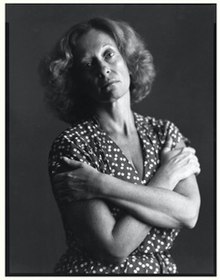 Barbara Rose in 1982 by Timothy Greenfield-Sanders | |
| Born | Barbara Ellen Rose (1936-06-eleven)June 11, 1936 Washington, D.C., U.Southward. |
| Died | December 25, 2020(2020-12-25) (anile 84) Concord, New Hampshire, U.Due south. |
| Education | Barnard College Columbia University |
| Occupation |
|
| Years active | 1963–2020 |
| Spouse(s) | Richard Du Boff (grand. 1959; div. 1960) (m. 2009–2020) Frank Stella (m. 1961; div. 1969) Jerry Leiber |
| Children | ii |
Barbara Ellen Rose (June xi, 1936 – December 25, 2020) was an American art historian, art critic, curator and higher professor. Rose'south criticism focused on 20th-century American art, particularly minimalism and abstruse expressionism, likewise as Spanish art. "ABC Art", her influential 1965 essay,[1] [two] defined and outlined the historical footing of minimalist art. She also wrote a widely used textbook, American Fine art Since 1900: A Critical History.
Early life and education [edit]
Barbara Ellen Rose was built-in on June 11, 1936,[3] in a Jewish family unit in Washington, D.C. to Lillian Rose (née Sand) and Ben Rose.[4] Her begetter owned a liquor store, and her mother was a homemaker.[v] [6] She graduated from Calvin Coolidge High School in the Takoma neighborhood of Washington D.C.[7]
At the age of 17, Rose enrolled at Smith College, only later two years transferred to Barnard College, where she received a B.A. in 1957.[8] She completed her graduate studies at Columbia University,[5] [9] studying with Meyer Schapiro, Julius S. Held, and Rudolf Wittkower,[vii] and started work on a PhD, but did non complete it.[10] She was somewhen awarded a PhD in history of art past Columbia in 1984.[11] The university accustomed "diverse books past Rose, published between 1970–1983" as her dissertation.[11] [3] [5]
In 1961, she received a Fulbright scholarship to visit Pamplona, Spain, which sparked a lasting interest in Castilian culture and art.[five] [ix] The cinematographer Michael Chapman introduced Rose to many New York artists, including Carl Andre and Frank Stella (to whom she was married 1961–69),[ix] [3] which gave her an insight into the New York art scene during the 1960s and 1970s.[12]
Career [edit]
Rose'southward showtime work of criticism was published in 1962.[13] She later noted that formalist art historian Michael Fried suggested she begin writing equally a critic.[v] Rose is credited with popularizing the term Neo-Dada in the early 1960s;[14] Harrison notes that Rose'southward 1963 publication describing pop fine art equally "neo-Dada" was her "entry into the field of contemporary American fine art criticism".[xv] Rose shortly argued that formalist criticism was inadequate to and so-contemporary art. She observed in a 1966 article that formalism, while appropriate for analysis of Cubism, was not equally useful as a disquisitional lens on abstract expressionism and other movements of the afterwards 20th century.[xvi] She wrote the textbook American Art Since 1900: A Critical History (1967), which became standard in campuses in the 1970s.[5] [17] From 1971 until 1977, she was an fine art critic for the New York magazine. In 1972, she received a Front Page Honour for her article "Artists with Convictions", which described the fine art program for inmates of the Manhattan House of Detention for Men.[18] She later worked equally an instructor at a New York Urban center correctional facility.[xix] She served as editor-in-main of the Journal of Fine art (from 1988).[3]
From 1981 until 1985, Rose was a senior curator at the Museum of Fine Arts, Houston, where she curated shows including Miró in America and Fernand Léger and the Modern Spirit: An Avant-Garde Culling to Non-Objective Art, both in 1982.[xx] In 1983, she curated the first Lee Krasner retrospective, which exhibited at the Museum of Fine Arts, Houston, and the Museum of Mod Art in New York City.[9] Rose frequently wrote on Krasner's work, describing her equally "1 of the seminal forces amidst the Abstract Expressionists";[21] in a 1977 article entitled "Lee Krasner and the Origins of Abstract Expressionism", she argued that Krasner had been unjustly overlooked by critics.[22] Rose'south books include over xx monographs nearly artists;[12] many of these were also about women, including Helen Frankenthaler (1971), and she besides wrote on Nancy Graves, Beverly Pepper and Niki de Saint Phalle.[23]
Rose taught art history at Sarah Lawrence College (from 1967) and was a visiting lecturer at Yale University (from 1970) and Hunter College (1987); she also taught at University of California, Irvine and University of California, San Diego, where she was Regent's Professor.[nine] [iii]
She wrote North Star: Mark di Suvero (1977), a documentary moving picture about the sculptor Marker di Suvero.[24] [25]
"ABC Art" [edit]
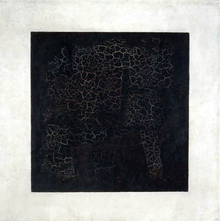
In October 1965, Rose published the essay "ABC Fine art" in Art in America, in which she describes the fundamental characteristics of what was afterwards known every bit minimal art. ("ABC fine art" was i of Rose's suggested names for the movement; she likewise suggested "reductive art" and "object sculpture".[26]) "ABC Art" considers the diverse roots of minimalism in the piece of work of Kasimir Malevich and Marcel Duchamp, as well as the choreography of Merce Cunningham, the art criticism of Clement Greenberg, the philosophy of Wittgenstein, and the novels of Alain Robbe-Grillet.[27] She regarded Advert Reinhardt as a progenitor of minimalism, and not a minimalist proper.[28] In examining the historical roots of minimal fine art in 1960s America, Rose drew a distinction between Malevich'due south "search for the transcendental, universal, absolute" and Duchamp'southward "blanket denial of the existence of absolute values".[29] Rose farther argued in "ABC Art" that minimalist sculpture was at its best when information technology was inhospitable to its audience: "hard, hostile, awkward and oversize".[xxx]
Rose grouped some 1960s artists equally closer to Malevich, some as closer to Duchamp, and some as between the two; she argued that the work of some minimalists constituted a "synthesis" of Malevich and Duchamp.[31] Closer to Malevich were Walter Darby Bannard, Larry Zox, Robert Huot, Lyman Kipp, Richard Tuttle, January Evans, Ronald Bladen, Anne Truitt. Closer to Duchamp were Richard Artschwager and Andy Warhol. Between Malevich and Duchamp she placed Robert Morris, Donald Judd, Carl Andre, and Dan Flavin. Her conclusion was that minimal art is both transcendental and negative:
The fine art I have been talking almost is obviously a negative art of denial and renunciation. Such protracted asceticism is usually the activity of contemplatives or mystics...Like the mystic, in their work these artists deny the ego and the individual personality, seeking to evoke, it would seem, the semihypnotic state of bare unconsciousness.[32]
She also assorted minimal fine art with Pop Fine art:
...if Pop Fine art is the reflection of our environment, perhaps the fine art I take been describing is its antidote, even if it is a hard i to swallow.[33]
Personal life [edit]
Rose was married four times to three men.[10] In 1959, she married Richard Du Boff, an economical historian;[5] the marriage ended in divorce afterwards a year.[10] In October 1961 in London, Rose married the artist Frank Stella;[5] [10] they had two children[half-dozen] and divorced in 1969.[iii] In the mid-1980s, she was living in Italian republic and purchased a villa in Perugia.[three] She married the lyricist Jerry Leiber in Rome, and the two returned to the US to alive in Greenwich Village. The wedlock ended in divorce after ten years.[20] [10] Rose remarried Du Boff in 2009.[7] [5]
Rose died from breast cancer on December 25, 2020, under hospice care in Hold, New Hampshire.[6] [5] [17]
Honors and awards [edit]
- 1967 and 1970: Higher Art Association, Frank Jewett Mather Award for Distinguished Art Criticism[34]
- 1972: New York, Front Page Honor for best cavalcade "Artists with Convictions"[18]
- 1980: Cinematics Golden Hawkeye honour for Lee Krasner: The Long View [9]
- 2010: Gild of Isabella the Catholic by the Spanish regime for her contributions to fine art history and Castilian culture[5]
Selected publications [edit]
[edit]
- Rose, Barbara (1966). American Painting: The Twentieth Century. Geneva: Skira. OCLC 562069716.
- Rose, Barbara (1967). American Art Since 1900: A Disquisitional History. New York: F.A. Praeger. ISBN978-0-275-43900-2. OCLC 1014107611. [35] [36]
- Rose, Barbara (1969). The Golden Age of Dutch Painting. New York: F.A. Praeger. ISBN978-0-269-67123-four. OCLC 741875627.
- Rose, Barbara (1970). Claes Oldenburg. Museum of Modern Art. OCLC 605363873. [37]
- Miró, Joan; Rose, Barbara; MacCandless, Judith; MacMillan, Duncan (1982). Miró in America. Houston, TX: Museum of Fine Arts, Houston. OCLC 252002405.
- Fabre, Gladys C.; Briot, Marie-Odile; Rose, Barbara (1982). Léger et l'esprit moderne: une alternative d'avant-garde à fifty'art non-objectif, 1918–1931 (Léger and the modern spirit: an advanced culling to not-objective art, 1918–1931). Paris: Musée d'art moderne de la ville de Paris. OCLC 192111155.
- Rose, Barbara (1983). Lee Krasner: A Retrospective. Houston: Museum of Fine Arts. ISBN978-0-870-70415-4. OCLC 10527746. [38]
- Rose, Barbara (1988). Autocritique: Essays on Fine art and Anti-Art, 1963–1987. New York: Weidenfeld & Nicolson. ISBN978-1-555-84076-1. OCLC 958961360.
Books edited [edit]
- Experiments in Art and Applied science (1972). Klüver, Baton; Martin, Julie; Rose, Barbara (eds.). Pavilion. New York: Due east.P. Dutton. OCLC 864533.
- Reinhardt, Advertizement; Rose, Barbara (1975). Fine art As Fine art: The Selected Writings of Ad Reinhardt. Berkeley: University of California Press. ISBN978-0-520-07670-nine. OCLC 605712700. [39] [40]
Articles [edit]
- Rose, Barbara (October 1965). "ABC Art". Art in America. 53 (five).
- Rose, Barbara (February 1993). "Is it fine art? Orlan and the transgressive act". Art in America. 81: 2.
Curated exhibitions [edit]
- 1969: Claes Oldenburg, Museum of Modern Fine art (New York City)[41]
- 1979: Abstruse Painting: The Eighties, Greyness Art Gallery, New York University (New York City)[42]
- 1982: Joan Miró, Museum of Fine Arts, Houston (Houston, Texas)[43]
- 1982–1983: Fernand Léger, Musée d'Art Moderne de Paris (Paris); Museum of Fine Arts, Houston (Houston, Texas); Musée Rath (Geneva)[44]
- 1983: Lee Krasner, Museum of Fine Arts, Houston (Houston, Texas); Museum of Modern Fine art (New York City)[45]
- 1992: Abstract Painting: The '90s, André Emmerich Gallery (New York City)[42]
- 2016: Painting Afterward Postmodernism, Vanderborght Building (Brussels)[46]
Filmography [edit]
- 1972: American Art in the 1960s, narrator[47] [48]
- 1972: The New York School, narrator[49]
- 1977: Due north Star: Mark di Suvero, author[24]
- 1988: Lee Krasner: The Long View [50]
See also [edit]
- Abstract illusionism
- Experiments in Art and Engineering science
References [edit]
- ^ Gruber, J. Richard (1999). Stackhouse. University Press of Mississippi. p. 33. ISBN978-1-890021-07-viii.
- ^ Atkins, Robert (1997). Artspeak (2nd ed.). Abbeville Publishing Grouping. p. 116. ISBN0-7892-0365-0. OCLC 36528407.
- ^ a b c d e f thou Sorensen, Lee. "Rose, Barbara Eastward." Dictionary of Art Historians. Archived from the original on December 28, 2020. Retrieved December 27, 2020.
- ^ "Barbara Eastward Rose, Usa Census, 1940". FamilySearch.
- ^ a b c d eastward f g h i j k Solomon, Deborah (Dec 27, 2020). "Barbara Rose, Critic and Historian of Modern Art, Dies at 84". The New York Times. Vol. 170, no. 58921. p. B8. Archived from the original on Dec 28, 2020.
- ^ a b c "Barbara Rose Obituary (2020)". The Washington Post. December 27, 2020. Archived from the original on December 28, 2020. Retrieved December 27, 2020.
- ^ a b c "Barbara Rose blossoms in earth of fine art". The Washington Times. May 18, 2002.
- ^ "Course of 1957". Barnard Alumnae. Archived from the original on December 28, 2020. Retrieved Dec 27, 2020.
- ^ a b c d east f "Barbara Rose" (PDF). The Museum of Modern Art. 1983. Archived (PDF) from the original on December 28, 2020. Retrieved December 27, 2020.
- ^ a b c d e Hashemite kingdom of jordan, Kathryn (equally told to) (April 1, 2019). "I Was Married Iv Times — One time to a Famous Artist". The Cut. New York Mag. Archived from the original on December 28, 2020. Retrieved Dec 27, 2020.
- ^ a b Rose, Barbara (1984). Selected Publications on Twentieth Century Art (PhD). Columbia Academy. OCLC 84093102. ProQuest 303285133. Archived from the original on December 28, 2020. Retrieved Dec 27, 2020.
- ^ a b Jocelyn Gibbs. "Finding aid for the Barbara Rose papers, 1940–1993 (bulk 1960–1985)". Online Annal of California. Retrieved December 29, 2020.
- ^ Dagen, Philippe (Dec 29, 2020). "Barbara Rose, critique et historienne d'fine art, est morte". Le Monde (in French). Retrieved December 29, 2020.
- ^ "The Guggenheim Museums and Foundation". The Guggenheim Museums and Foundation . Retrieved December 28, 2020.
- ^ Harrison 2001, p. 116.
- ^ Tekiner 2006, pp. 38–39.
- ^ a b Greenberger, Alex (Dec 27, 2020). "Barbara Rose, Impassioned Critic Who Reshaped Art History, Has Died at 84". ARTnews. Archived from the original on December 28, 2020. Retrieved December 27, 2020.
- ^ a b "Newswomen Name Winners of Awards". The New York Times. November 22, 1972. Archived from the original on December 28, 2020. Retrieved November xi, 2020.
- ^ Newman, Amy (2000). Challenging Art: Artforum 1962–1974 . Soho Press Inc. p. 481. ISBN1-56947-207-6.
- ^ a b Glueck, Grace (April 3, 1981). "Art People: The Talk of Houston". The New York Times. p. C21. Archived from the original on Dec 28, 2020.
- ^ Levin 2011, p. 399.
- ^ Levin 2011, pp. 409–410.
- ^ Wallace Ludel (December 28, 2020). "Art historian Barbara Rose—Minimalism cheerleader and champion of women artists—has died, aged 84". The Art Newspaper . Retrieved December 29, 2020.
- ^ a b Cascone, Sarah (Oct 10, 2017). "Editors' Picks: 18 Things to Come across in New York This Week". Artnet. Archived from the original on Dec 28, 2020. Retrieved December 28, 2020.
- ^ North Star: Mark di Suvero (35 mm flick impress). Parott Productions. 1977. OCLC 56611375.
- ^ Strickland 1993, p. 17.
- ^ Smith, William S. (Dec 28, 2020). "More than Is Less". ARTnews. Archived from the original on Dec 28, 2020. Retrieved Dec 28, 2020.
- ^ Strickland 1993, p. 22.
- ^ Motte, Warren F. (1999). Small Worlds: Minimalism in Contemporary French Literature. University of Nebraska Press. p. 9. ISBN978-0-8032-3202-0. Archived from the original on Dec 28, 2020. Retrieved Dec 28, 2020.
- ^ Ratcliff 1996, p. 269.
- ^ "Barbara Rose (1936–2020)". Artforum. Archived from the original on Dec 28, 2020. Retrieved December 28, 2020.
- ^ Gamwell, Lynn (2016). Mathematics and Art: A Cultural History. Princeton University Printing. p. 442. ISBN978-0-691-16528-viii. Archived from the original on December 28, 2020. Retrieved December 28, 2020.
- ^ Fink, Robert (2005). Repeating Ourselves: American Minimal Music as Cultural Do. Academy of California Press. p. 73. ISBN978-0-520-24036-0.
- ^ "Programs: Awards for Distinction: Frank Jewett Mather Accolade". College Art Clan of America (CAA). Archived from the original on February 4, 2017. Retrieved December 27, 2020.
- ^ Sewell, David (June 1969). Art Journal. 28 (4): 448–452. doi:10.1080/00043249.1969.10793947. ISSN 0004-3249.
{{cite journal}}: CS1 maint: untitled periodical (link) - ^ Verdier, Philippe (1969). Fine art Journal. 28 (4): 440. doi:10.2307/775326. JSTOR 775326.
{{cite journal}}: CS1 maint: untitled periodical (link) - ^ Goldin, Diana; Shaw, Elizabeth (May 31, 1970). "Claes Oldenburg by Barbara Rose" (PDF). The Museum of Modern Art. Archived (PDF) from the original on Dec 28, 2020. Retrieved December 27, 2020.
- ^ Hobbs, Robert (1987). "Lee Krasner: A Retrospective". Adult female's Art Journal. 8 (1): 43. doi:10.2307/1358340. JSTOR 1358340.
- ^ Schjeldahl, Peter (February 15, 1976). "Art equally Art". The New York Times. ISSN 0362-4331. Archived from the original on December 28, 2020. Retrieved Dec 28, 2020.
- ^ Paskus, Benjamin Thousand. (Dec 1976). Art Journal. 36 (2): 172–176. doi:x.1080/00043249.1977.10793348. ISSN 0004-3249.
{{cite journal}}: CS1 maint: untitled periodical (link) - ^ Rose, Barbara (1970). Claes Oldenburg. The Museum of Modern Art, New York. OCLC 605363873.
- ^ a b Plagens, Peter (January 13, 1992). "Last-Minute Reprieve: Is abstract painting dead? Not if curator Barbara Rose can aid it". Newsweek. Vol. 119, no. 2. pp. 62–63. ProQuest 1879105997.
- ^ Miró, Joan; Rose, Barbara; MacCandless, Judith; MacMillan, Duncan (1982). Miró in America. Houston, TX: Museum of Fine Arts, Houston. OCLC 252002405.
- ^ Fabre, Gladys C.; Briot, Marie-Odile; Rose, Barbara (1982). Léger et l'esprit moderne: une culling d'avant-garde à l'art non-objectif, 1918–1931 = Léger and the modern spirit : an avant-garde alternative to non objective art, 1918–1931. Paris: Musée d'art moderne de la ville de Paris. OCLC 192111155.
- ^ Rose, Barbara (1983). Lee Krasner: A Retrospective. Houston: Museum of Fine Arts. ISBN978-0-870-70415-four. OCLC 10527746.
- ^ Herriman, Kat (as told to) (September 23, 2016). "Barbara Rose discusses "Painting After Postmodernism: Kingdom of belgium – Us"". Artforum. Archived from the original on Dec 28, 2020. Retrieved December 27, 2020.
- ^ "FILM & TALK: American Art in the 1960s". Parrish Art Museum. Archived from the original on December 28, 2020. Retrieved December 28, 2020.
- ^ Arghyros, Nan (February 20, 1975). "Barbara Rose shows film at ICA". The Boston Globe. p. 20. ProQuest 655527185.
- ^ "The New York School (1972)". Royal University of Arts. Archived from the original on Dec 28, 2020. Retrieved December 28, 2020.
- ^ "Art People". The New York Times. November 24, 1978.
Sources [edit]
- Harrison, Sylvia (August 27, 2001). "Barbara Rose: Pop, Pragmatism, and 'Prophetic Pragmatism'". Pop Fine art and the Origins of Post-Modernism. Cambridge University Printing. pp. 115–145. doi:10.1017/cbo9780511497681.006. ISBN978-0-521-79115-1.
- Levin, Gail (2011). Lee Krasner: A Biography . William Morrow and Company. ISBN978-0-06-184525-3. OCLC 641532157.
- Ratcliff, Carter (1996). The Fate of a Gesture: Jackson Pollock and Postwar American Fine art . Farrar, Straus and Giroux. ISBN0-374-22331-9. OCLC 32236025.
- Strickland, Edward (1993). Minimalism: Origins . Indiana University Press. ISBN0-253-21388-half-dozen. OCLC 45261676.
- Tekiner, Deniz (2006). "Formalist Art Criticism and the Politics of Pregnant". Social Justice. 33 (two): 31–44. ISSN 1043-1578. JSTOR 29768369.
External links [edit]
- Barbara Rose at The Brooklyn Track
- Barbara Rose papers, 1940–1993 (majority 1960–1985) at the Getty Research Establish
- Barbara Rose papers, 1962–circa 1969 at the Athenaeum of American Fine art, Smithsonian Establishment
- Barbara Rose at IMDb

Source: https://en.wikipedia.org/wiki/Barbara_Rose
0 Response to "Rose Barbara ââåã¢âëœabc Artã¢â⢠Art in Americaã¢ââ 53 No3 October ââ“november 1965"
Postar um comentário